Solar Panel Efficiency: What It Means and Why It Matters
Efficiency determines how many watts you extract from each square foot of roof. Here is what the numbers mean, what drives them, and when paying more for higher efficiency actually pays off.
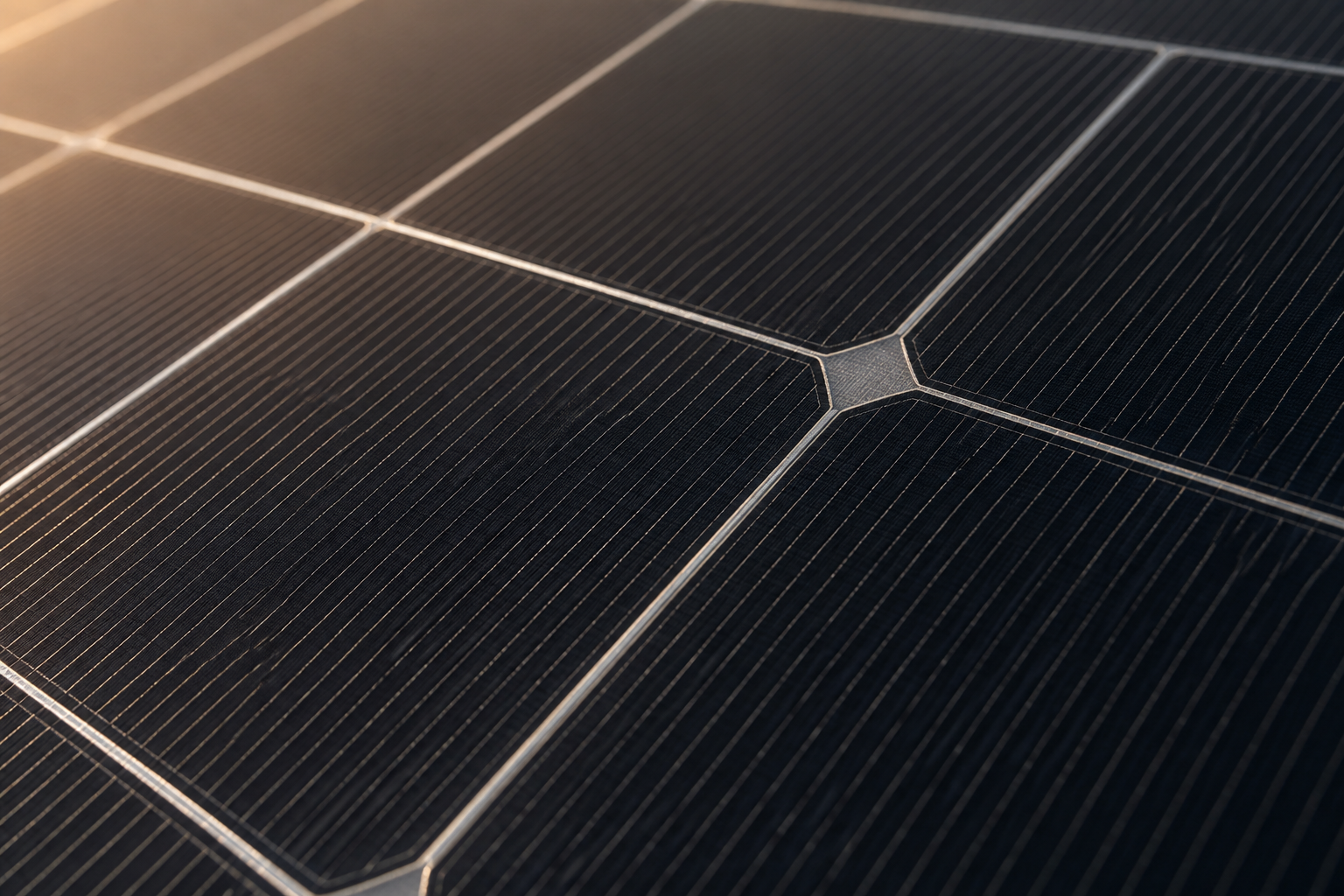
Solar panel efficiency is simply the percentage of sunlight energy hitting the panel surface that gets converted into usable electricity. A 400-watt panel with 21 % efficiency captures 21 % of the solar energy striking its roughly 19 square feet of surface area under standard test conditions (1,000 W/m² irradiance, 25 °C cell temperature, AM 1.5 spectrum). The rest becomes heat or reflects away. Efficiency is not the only metric that matters, but it dictates how much roof area you need for a given system size, and that single constraint shapes economics for millions of homeowners.
Residential panels shipping in 2026 range from about 19 % at the budget end to 24 % for premium products from manufacturers like SunPower and Maxeon. That five-point spread translates to roughly 20 % fewer panels (and 20 % less roof space) to hit the same system wattage. On a large, unobstructed roof the difference is mostly academic. On a compact or heavily shaded roof, those extra percentage points determine whether you can offset your full electricity bill or fall short.
What efficiency means
Standard test conditions (STC) provide the baseline. Every panel is flash-tested in the factory under 1,000 watts per square meter of simulated sunlight at a cell temperature of 25 °C. The ratio of electrical output to incoming solar energy at that moment is the nameplate efficiency. A 21 % efficient panel measuring 1.7 m² receives 1,700 watts of light and converts 357 watts to DC electricity. This standardized snapshot lets you compare panels from different factories on equal terms, but it does not represent real rooftop conditions.
Real-world efficiency varies minute to minute. Cell temperature on a hot roof can exceed 65 °C, reducing output by 8 % to 12 % from STC ratings. Soiling, angle of incidence, spectral mismatch, and wiring losses all chip away at nameplate numbers. Your actual annual yield depends on local climate, tilt, orientation, and shading patterns far more than the one or two efficiency points separating mid-tier and premium panels.
Want research like this in your inbox? Become a subscriber, free, no sales pitch.
Become a subscriber →What drives efficiency
Cell technology
Monocrystalline silicon dominates the high-efficiency market. The uniform crystal structure provides a consistent path for electron flow, minimizing recombination losses. Polycrystalline silicon, with its grain boundaries, caps around 17 % to 18 % at the module level. Heterojunction (HJT) and interdigitated back contact (IBC) architectures push mono cells past 24 % by reducing surface recombination and eliminating front-side shading from busbars.
Passivation and coatings
PERC (Passivated Emitter and Rear Cell) technology adds a dielectric layer to the rear of the cell that reflects unabsorbed photons back through the silicon for a second chance at conversion. This single change lifted mainstream mono efficiency from about 19 % to 21 % over the past decade. TOPCon (Tunnel Oxide Passivated Contact) is the next step, replacing the aluminum rear with a thin tunnel oxide that further reduces recombination, pushing commercial modules toward 22 % to 23 %.
Temperature coefficient
Every panel loses output as temperature rises. The temperature coefficient, expressed as a percentage loss per degree Celsius above 25 °C, typically ranges from -0.29 %/°C for premium HJT modules to -0.40 %/°C for standard PERC. On a roof hitting 50 °C, that difference amounts to roughly 2.5 % more energy from the premium panel over the course of a hot afternoon. In cooler climates the advantage shrinks.
2026 efficiency ranges
- Budget monocrystalline (PERC): 19.5 % to 21 %
- Mainstream monocrystalline (PERC/TOPCon): 21 % to 22.5 %
- Premium (HJT / IBC): 22.5 % to 24.2 %
- Polycrystalline (legacy): 16 % to 18 %, rarely installed new
- Thin-film (CdTe): 18 % to 19 % (First Solar Series 7)
When it matters most
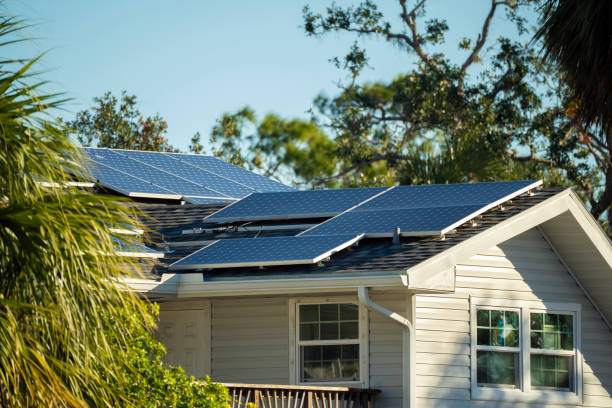
Efficiency becomes the deciding factor when roof space is constrained. If you have 250 square feet of usable south-facing area and need 8 kW, you cannot reach that target with 19 % panels but you can with 23 % panels. The math is simple: higher watts per panel means fewer panels needed, fewer rails, fewer attachments, and often a simpler permitting package. On a 1,500-square-foot roof with no obstructions, the cheapest panel that meets your wattage target is usually the best economic choice regardless of its efficiency rating.
Real-world vs lab numbers
The National Renewable Energy Laboratory (NREL) maintains a chart tracking record cell efficiencies. Lab records exceed 47 % for multi-junction concentrator cells, but those are aerospace-grade devices costing thousands per square centimeter. Commercial residential cells sit at roughly half the theoretical single-junction limit of 33.7 % (the Shockley-Queisser limit for silicon). Gains from here will be incremental, perhaps 0.3 % to 0.5 % per year in commercial products. Do not wait for a breakthrough; today's panels are already within striking distance of practical limits.
Real annual production also depends on the "performance ratio," which accounts for all system losses: inverter conversion, wiring, soiling, clipping, and temperature. A well-designed residential system achieves a performance ratio of 0.78 to 0.85. Multiplying nameplate efficiency by the performance ratio gives you a better sense of actual energy captured per square meter per year.
Is the premium worth it
Premium panels (SunPower Maxeon, REC Alpha, Panasonic EverVolt) typically cost $0.10 to $0.20 more per watt than mainstream PERC modules. On a 7 kW system, that is $700 to $1,400 extra. The payback on that premium depends entirely on whether the extra efficiency lets you install more capacity on a space-constrained roof. If your roof easily fits the system you need with mainstream panels, the premium buys bragging rights but not additional energy. If you are five panels short of your target and premium panels close the gap, the incremental cost is justified by the additional production.
Small or shaded roof? Pay up for 22 %+ efficiency. Large, clear roof? Buy mainstream 20 % to 21 % panels and pocket the savings. Either way, the inverter, racking, and installation quality matter more to lifetime production than the last point of cell efficiency. Compare PERC vs standard for a deeper technology dive.
Common questions
What is a good efficiency for solar panels in 2026?+
Anything above 20 % is solid for residential use. Mainstream panels sit between 20 % and 22 %, and premium options reach 23 % to 24 %. Below 19 % typically means older polycrystalline technology that is rarely worth installing new.
Does higher efficiency mean more electricity?+
Per square foot of panel, yes. But total system output depends on how many panels you install. A larger array of lower-efficiency panels can produce more total energy than a smaller array of high-efficiency ones. Efficiency matters most when roof space is limited.
Will solar panel efficiency keep improving?+
Yes, but incrementally. Commercial gains have averaged about 0.3 % to 0.5 % per year. Silicon cells are approaching their theoretical limit of 29.4 %, so future leaps will require tandem or perovskite layers, which are still years from mainstream residential availability.
Become a subscriber
Free updates on costs, incentives and panel tech, written for homeowners, not sales teams.
Become a subscriber →