Monocrystalline vs polycrystalline: which is better?
Efficiency, looks and cost, and when the cheaper cell type is the smarter buy.
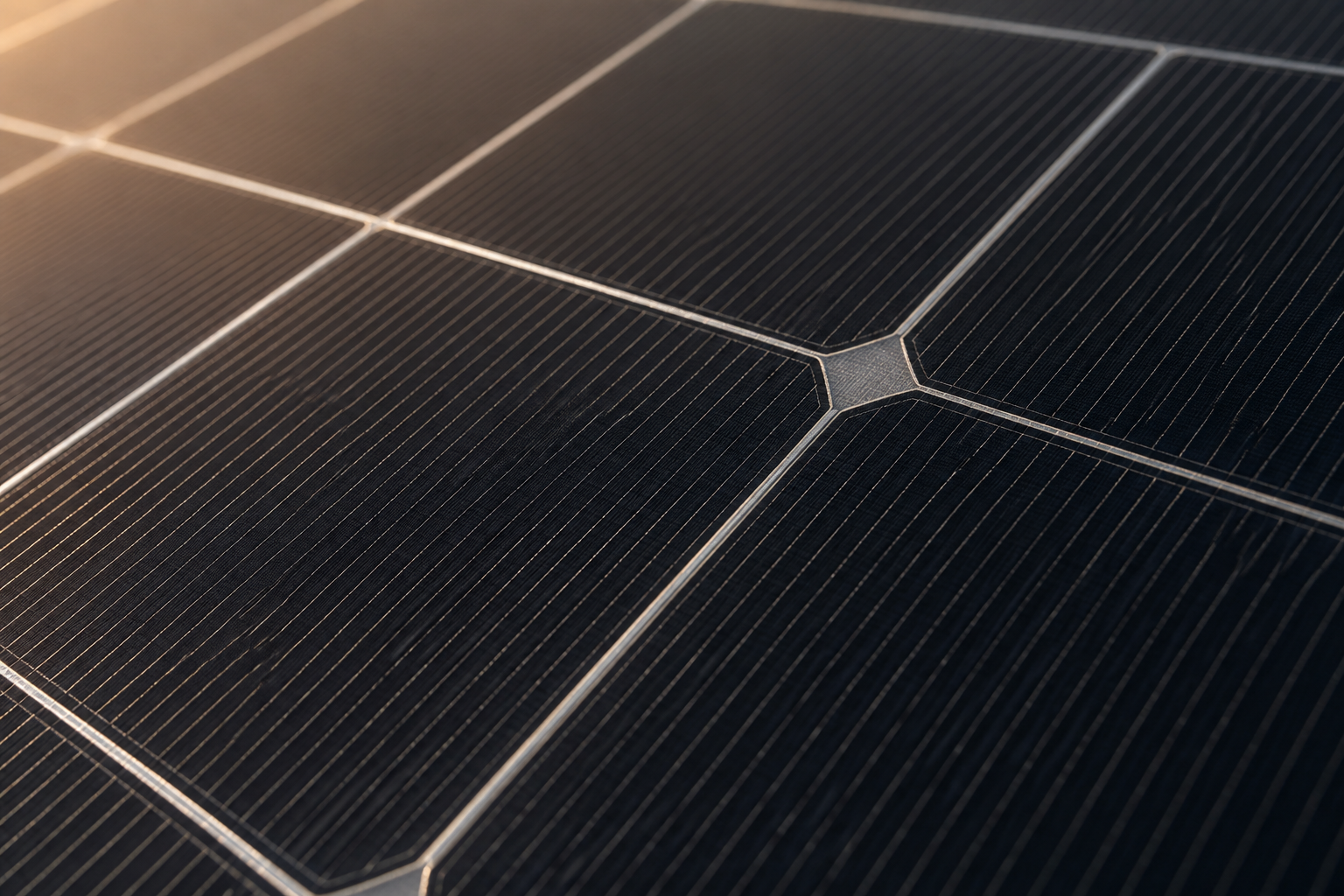
Monocrystalline and polycrystalline are two ways to grow the silicon that forms a solar cell. Monocrystalline cells are sliced from a single, continuous crystal ingot, the Czochralski process, which produces a uniform atomic structure, higher electron mobility, and a characteristic dark black appearance. Polycrystalline cells are cast from molten silicon fragments that solidify into a block of multiple smaller crystals, resulting in slightly lower efficiency, a bluer speckled surface, and a lower manufacturing cost per wafer.
In 2026, the US residential market is overwhelmingly mono. Polycrystalline modules still appear in value-oriented bids, ground-mount projects, and inventory from older production runs, but the price gap between the two has narrowed to the point where most installers default to mono for rooftop applications. That said, "mono is always better" is an oversimplification. The right choice depends on your roof size, shading, budget, and what your installer can actually source and warranty locally.
The real differences
The core difference is cell-level efficiency. Monocrystalline cells convert a higher percentage of incoming light to electricity because their uniform crystal structure allows electrons to flow with less resistance. In practical terms, a mono panel rated at 400 watts occupies roughly the same physical footprint as a poly panel rated at 340 to 360 watts. That 10 % to 15 % advantage in power density means fewer panels to reach the same system size, which translates to less racking, less wiring, and fewer roof penetrations.
Aesthetically, mono panels are almost universally preferred. Their dark, uniform appearance blends with most roofing materials and satisfies HOA design committees that reject the blue patchwork look of poly modules. For homeowners who care about curb appeal, or who are required to by their HOA, mono is effectively the only option. Poly's blue speckled surface is perfectly functional but polarizing in neighborhoods where appearance matters to resale value.
Want research like this in your inbox? Become a subscriber, free, no sales pitch.
Become a subscriber →Efficiency and output
Residential monocrystalline modules in 2026 typically rate between 20 % and 23 % efficiency, with premium models touching 24 %. Polycrystalline modules land between 16 % and 18 %. In absolute terms, that gap means a mono array on a 300-square-foot roof section might produce 5.5 kW while a poly array on the same footprint produces 4.5 kW. Over a year in a decent solar market, that one-kilowatt difference generates roughly 1,300 to 1,500 additional kilowatt-hours, enough to matter on a small roof but negligible if you have ample unshaded space to add extra poly panels.
Temperature coefficient is another subtle difference. Mono cells lose slightly less output per degree of temperature rise above 25 °C (the standard test condition). In hot climates, Phoenix, Las Vegas, Houston, this gives mono a small additional edge during the summer months when roof temperatures can exceed 70 °C. The difference is modest, typically 0.02 to 0.05 percentage points per degree, but it compounds over a 25-year system life.
When mono wins
Mono is the clear choice on small roofs, complex multi-plane roofs, partially shaded installations, and any project where HOA rules dictate aesthetics. It also wins when you want headroom for future electrification, adding an EV or heat pump later, without covering every remaining shingle. Because mono packs more watts per square foot, a 7 kW mono array leaves room for a future two-kilowatt expansion that a poly array of the same size would not.
Specific scenarios favoring mono
- Urban roofs under 250 sq ft of usable area: every watt per square foot matters.
- Roofs with dormers, chimneys, and vents: fewer panels means simpler layout and fewer shade interactions.
- HOA-controlled neighborhoods: all-black mono modules typically pass architectural review.
- Homes planning future EV charging or heat pump installation: leave roof capacity for expansion.
When poly still makes sense
Large, unshaded roofs where the cost difference per watt between mono and poly is meaningful, and where you have physical space to add the extra panels poly requires, are the remaining stronghold for polycrystalline. A farmer or rural homeowner with a massive barn roof and no shade trees can install a 12 kW poly system for less than a 12 kW mono system and achieve the same annual production by simply covering more area. The labor warranty and inverter choice will dwarf the cell-technology decision in those scenarios.
Ground-mount systems also suit poly well. Without the space constraints of a rooftop, ground arrays can spread out to accommodate poly's larger footprint per watt. And because ground mounts are easier to access for maintenance, the slightly higher degradation rate of some poly modules is less of a concern, you can physically inspect and clean them without climbing on a roof.
PERC, TOPCon and beyond
PERC (Passivated Emitter and Rear Cell) is a mono refinement that adds a reflective passivation layer to the back of the cell, capturing photons that would otherwise pass through. Most mono panels shipping in 2026 use PERC or its successors. TOPCon (Tunnel Oxide Passivated Contact) goes further, adding a thin tunnel oxide layer that reduces recombination losses and pushes commercial efficiency above 23 %. Heterojunction (HJT) cells combine crystalline silicon with thin-film amorphous layers for excellent temperature coefficients and bifacial gain.
For the homeowner, these distinctions are datasheet details inside the mono family. What matters practically is the resulting efficiency, degradation rate, and warranty, not the acronym on the cell architecture. If your installer proposes a TOPCon panel, compare its $/W and warranty terms against a PERC alternative on the same bid. If the TOPCon module costs more but doesn't deliver meaningfully better lifetime kWh for your specific roof, the upgrade isn't worth the premium.
Temperature and climate performance
Temperature coefficient measures how much a panel's output drops for every degree Celsius above 25 °C, the standard test condition. Monocrystalline PERC panels typically carry a temperature coefficient of −0.34 % to −0.38 %/°C, while advanced architectures like HJT achieve −0.24 % to −0.28 %/°C. On a Phoenix rooftop in July, where cell temperatures routinely hit 65, 75 °C, that difference translates to roughly 2 % to 4 % more production from HJT versus standard PERC on the hottest days. Over a full year and a 25-year system life, the cumulative gain from a better temperature coefficient can amount to several thousand additional kilowatt-hours, enough to offset the higher upfront cost in the hottest markets.
Bifacial panels, modules that capture reflected light on the rear side, add another dimension to the mono advantage. Bifacial cells generate 5 % to 15 % more energy when mounted above a reflective surface like white roofing membrane, light-colored concrete, or snow. Most bifacial modules use mono cells in a glass-glass construction that also improves durability and reduces degradation. For ground-mount arrays or flat commercial roofs with white membranes, bifacial mono panels can meaningfully improve project economics. On a conventional shingle roof with minimal rear-side irradiance, the bifacial premium is usually not worth paying.
Making the final choice
The decision tree is simpler than the marketing suggests. If your roof is small, shaded, or HOA-controlled, choose mono, it's the only practical option. If your roof is large and unshaded and the poly bid is meaningfully cheaper per watt, poly can make economic sense. In most other cases, mono is the default because the price gap has narrowed to the point where the efficiency advantage comes at minimal extra cost. Always compare lifetime kWh cost, not sticker wattage, and prioritize installer quality over cell technology.
Ultimately, the panel on your roof matters less than the crew that installs it and the company that stands behind the warranty. A well-installed mid-tier mono panel will outperform a poorly installed premium panel over 25 years, and certainly outperform a premium panel from a manufacturer that went bankrupt in year eight. Pair this decision with our brand rankings for warranty specifics and 2026 cost data for current pricing.
Mono wins on efficiency, aesthetics, and space efficiency. Poly wins on raw $/W when roof area isn't a constraint. In 2026, the price gap is small enough that mono is the default for most residential rooftops. Don't overthink cell type, spend that energy vetting your installer instead.
Common questions
Is poly obsolete?+
Not obsolete, but significantly less common in new US residential installations. Poly still ships for utility-scale, ground-mount, and value-oriented projects where space is abundant and cost per watt is the primary metric.
Can I mix mono and poly on one roof?+
Technically possible but generally inadvisable. Mixing cell types complicates string design, creates monitoring headaches, and produces an aesthetically inconsistent roofline. Stick to one technology family per installation.
Does mono always cost more installed?+
Per watt, mono is often slightly more expensive. But per lifetime kilowatt-hour on a space-constrained roof, mono frequently delivers better economics because you generate more energy from the same footprint with fewer panels and less racking hardware.
Become a subscriber
Free updates on costs, incentives and panel tech, written for homeowners, not sales teams.
Become a subscriber →