PERC vs Standard Solar Panels: Complete Breakdown
PERC technology lifted mainstream panel efficiency past 21 %. Here is how the passivated rear cell works, what it costs, and whether upgrading from standard aluminum BSF panels is still worth the price gap.
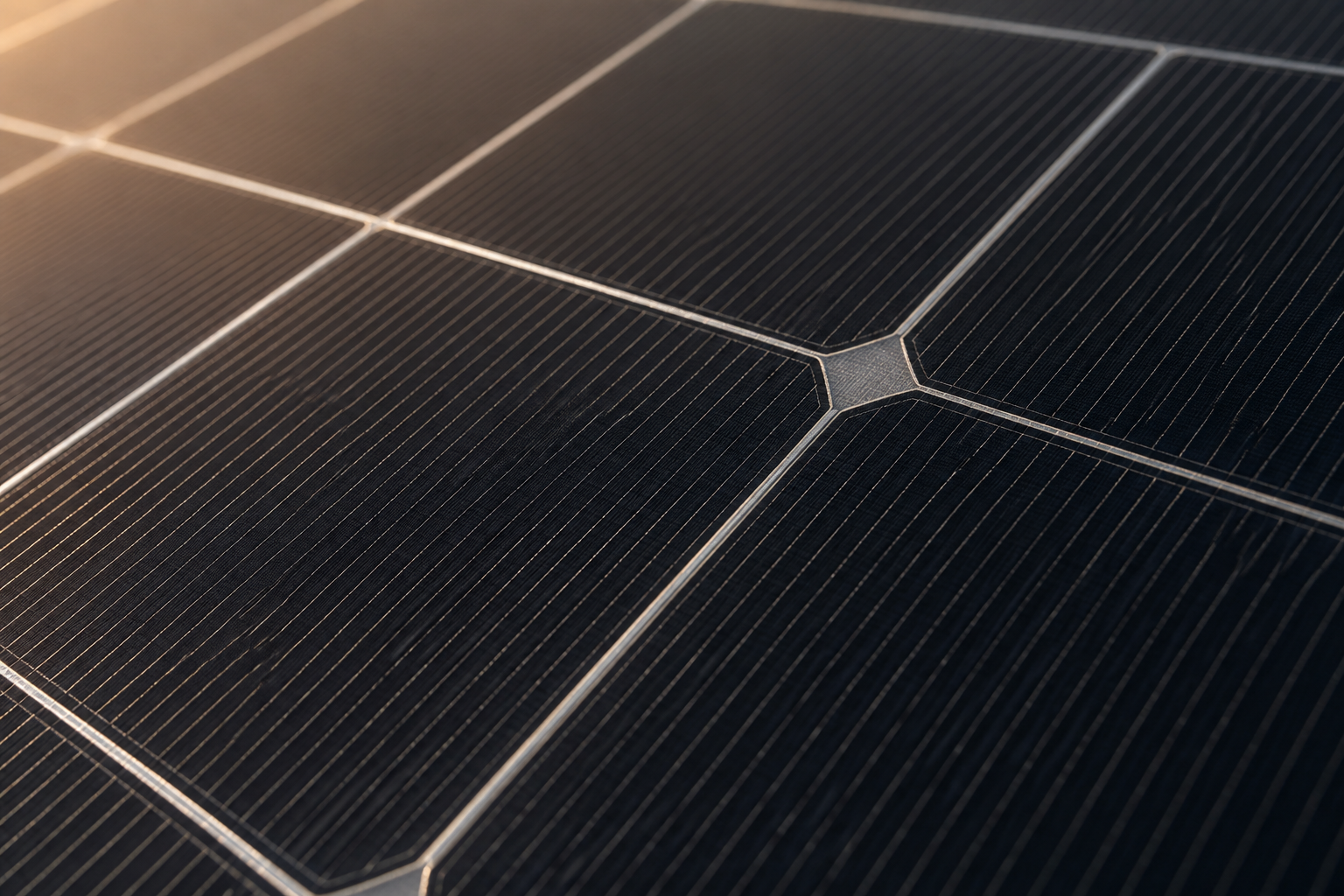
PERC stands for Passivated Emitter and Rear Cell (sometimes Rear Contact). It is an enhancement to standard monocrystalline manufacturing that adds a thin dielectric passivation layer to the back surface of each solar cell. That layer serves two purposes: it reflects photons that passed through the silicon without being absorbed back for a second chance at generating current, and it reduces electron recombination at the rear surface. The combined effect lifts module efficiency by 1 to 1.5 absolute percentage points over conventional aluminum back-surface field (BSF) designs, pushing mainstream residential panels from roughly 19 % into the 20.5 % to 22 % range.
By 2026, PERC has become the default cell architecture for new residential installations. Over 85 % of monocrystalline modules shipping globally use some form of rear passivation. "Standard" aluminum BSF panels are largely legacy inventory or budget-tier products. The practical question for homeowners is not whether to choose PERC, you almost certainly will, but whether to pay extra for next-generation upgrades like TOPCon or HJT that build on the PERC foundation. Understanding where PERC sits in the technology stack helps you evaluate proposals and avoid overpaying for yesterday's innovation marketed as premium.
How PERC works
In a standard silicon solar cell, the rear surface is covered entirely by aluminum paste that forms a back-surface field. This structure works, but it absorbs long-wavelength photons that reach the back without contributing to current, and it provides only modest passivation of the silicon surface. PERC replaces most of that aluminum with a layer of aluminum oxide or silicon nitride, opened at regular intervals with laser-fired contacts to maintain electrical connection. The dielectric layer reflects infrared light back into the cell and dramatically reduces rear-surface recombination velocity.
The manufacturing addition is relatively simple: one or two extra deposition and laser steps on existing cell production lines. That simplicity is why PERC adoption was so rapid once the patent landscape cleared in the mid-2010s. Factories could retrofit lines for a few cents per watt of additional capex and immediately gain meaningful efficiency uplift and thus higher revenue per module shipped.
Want research like this in your inbox? Become a subscriber, free, no sales pitch.
Become a subscriber →What standard BSF means
Aluminum back-surface field technology dates to the earliest commercial solar cells. The full-area aluminum rear contact creates a modest electric field that pushes minority carriers away from the recombination-heavy back surface. It is cheap, proven, and simple, but it leaves performance on the table. BSF cells typically max out around 19 % to 19.5 % module efficiency because the aluminum absorbs rear-incident photons and the passivation quality is limited. You will still see BSF modules sold as entry-level or utility-scale commodity products, but residential installers rarely stock them for new projects in 2026.
Efficiency comparison
- Standard BSF mono: 18.5 % to 19.5 % module efficiency
- PERC mono: 20.5 % to 22 % module efficiency
- TOPCon (PERC successor): 22 % to 23.2 % module efficiency
- HJT (heterojunction): 22 % to 24 % module efficiency
The 1.5 to 2 point gap between BSF and PERC translates to roughly 30 to 40 more watts per standard-size panel. On a 20-panel system, that is 600 to 800 watts of additional capacity for minimal extra cost, often enough to add one fewer panel to the array while hitting the same system target. The compounding benefit is fewer roof penetrations, less racking, and a cleaner installation layout.
Cost difference
At the module level, PERC panels command a premium of roughly $0.02 to $0.05 per watt over BSF equivalents. On a 7 kW system, that is $140 to $350 in extra module cost, easily recovered through the higher energy production within the first year. In practice, most installers no longer offer BSF as a choice; PERC is the baseline product in their catalog. Price comparisons in 2026 are more relevant between PERC and the next generation (TOPCon), where the premium is $0.03 to $0.08 per watt and the efficiency gain is more modest.

Long-term degradation
PERC cells experienced early concerns about light-induced degradation (LID) and light-and-elevated-temperature-induced degradation (LeTID). These phenomena cause efficiency drops in the first hours or months of sun exposure. Manufacturers have addressed both through hydrogen passivation treatments and process optimizations. Current-generation PERC modules degrade at 0.4 % to 0.55 % per year, comparable to historical BSF rates. Top-tier PERC products from manufacturers like LONGi and Trina warranty 84.8 % output at year 25, implying confidence in long-term stability.
TOPCon and HJT cells show potentially lower degradation, around 0.3 % to 0.4 % per year in early field data, because their passivation structures are inherently more robust. If degradation rate is a priority, next-gen architectures offer a modest advantage, but the field data covers fewer years and should be treated as preliminary.
Which to choose in 2026
If your installer is quoting BSF panels in 2026, ask why. The cost savings are minimal and the efficiency sacrifice is meaningful. PERC should be your baseline, and the real decision is whether to step up to TOPCon or HJT for another 1 to 2 efficiency points at a slightly higher cost. For space-constrained roofs, that upgrade is often worthwhile. For large open roofs, mainstream PERC delivers excellent economics without the premium. Either way, inverter selection, installation quality, and system design matter more to lifetime production than the cell architecture alone.
PERC is not a premium upsell anymore, it is the industry standard. If someone positions PERC as a "high-efficiency upgrade" in 2026, they may be comparing to obsolete BSF inventory. The real upgrade conversation is PERC vs TOPCon or HJT. See our efficiency guide for the full landscape.
Common questions
Is PERC better than standard solar panels?+
Yes. PERC delivers 1.5 to 2 percentage points higher efficiency for minimal extra cost. It has replaced standard BSF as the default residential cell technology and should be considered the baseline, not an upgrade, in 2026.
Do PERC panels degrade faster?+
Early PERC production had LID and LeTID concerns, but current manufacturing processes have largely solved these issues. Modern PERC modules degrade at 0.4 % to 0.55 % per year, on par with historical BSF performance.
What comes after PERC?+
TOPCon (Tunnel Oxide Passivated Contact) is the immediate successor, offering 22 % to 23 % module efficiency on similar manufacturing lines. HJT (heterojunction) and tandem perovskite-silicon cells represent further steps, with HJT already shipping at 22 % to 24 %.
Become a subscriber
Free updates on costs, incentives and panel tech, written for homeowners, not sales teams.
Become a subscriber →