DIY solar panels vs professional installation
Where DIY saves money, where it voids warranties, and when a licensed crew is non-negotiable.
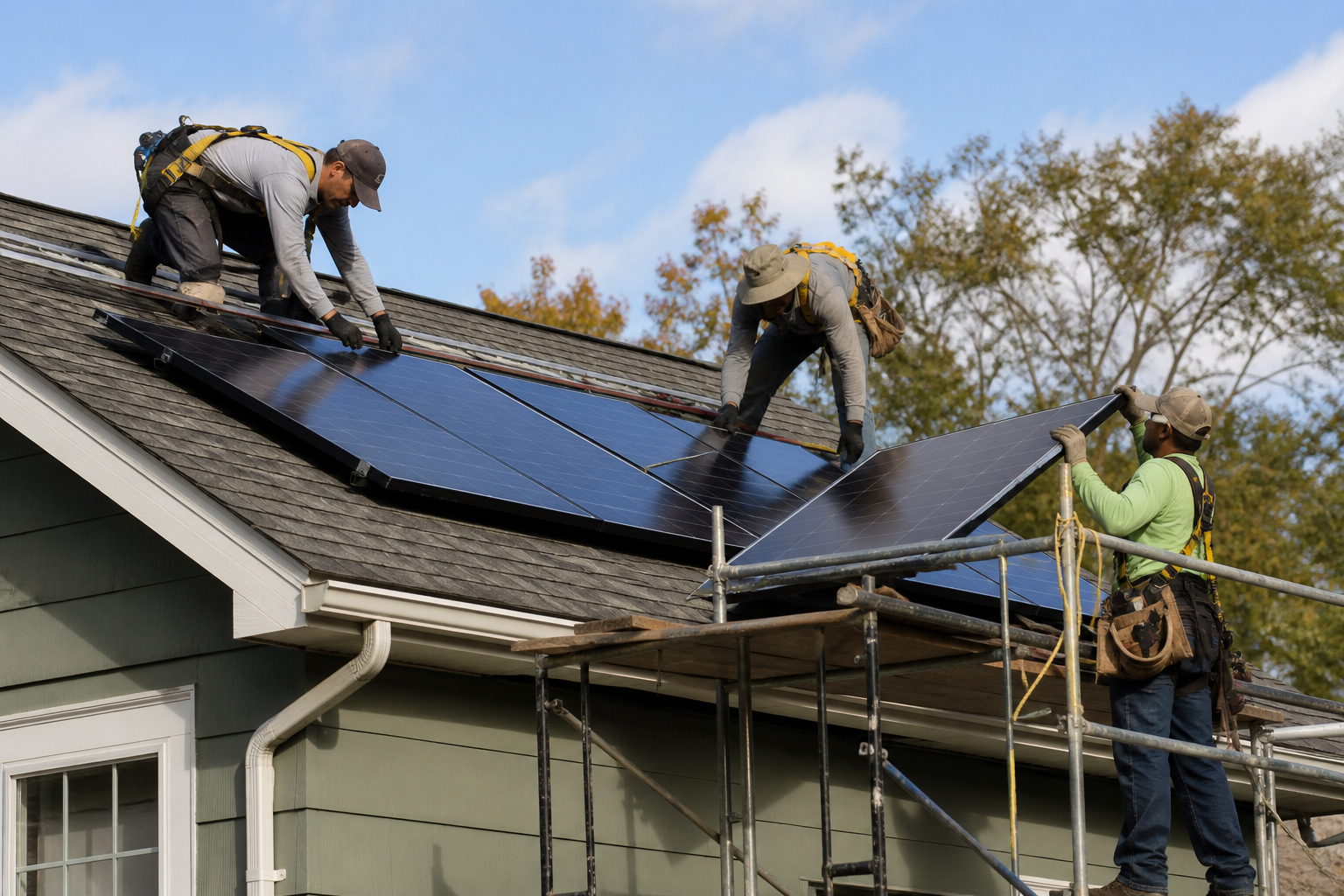
The appeal of DIY solar is obvious: professional installation labor accounts for 15 % to 25 % of total system cost, and YouTube makes the mechanical work look approachable. Balcony kits, portable ground arrays, and off-grid cabin systems in permissive jurisdictions can genuinely be DIY-friendly projects. But a roof-penetrating, grid-tied residential system in most US jurisdictions is not a weekend project. The real barriers are not the torque wrench or the rail layout, they are insurance, interconnection agreements, roof warranties, and electrical code compliance.
Before you order panels from an online retailer, understand the full scope of what "doing it yourself" entails. You need to produce or commission an engineered structural and electrical design, file building and electrical permit applications, pass a municipal inspection, file a utility interconnection application that typically requires a licensed electrician of record, maintain your homeowner's insurance coverage, and preserve your roof warranty. Each of these steps has consequences for failure that extend well beyond the cost of professional labor.
When DIY can work
Off-grid cabins and outbuildings are the strongest DIY use case. With no utility interconnection, no net metering application, and often no building permit requirement, you can install panels, a charge controller, batteries, and an inverter at your own pace. Portable solar kits for RVs, boats, and camping are similarly straightforward. Plug-in balcony and ground-mount systems in jurisdictions that allow them, typically under 1 kW and with simplified interconnection rules, are another viable DIY category.
In these scenarios, the electrical complexity is lower, the structural risk is minimal (no roof penetrations), and the regulatory burden is light or nonexistent. You can buy components at retail, panels, micro-inverters, racking, and wiring, and assemble a functional system for 30 % to 50 % less than a professional install. The key is knowing which category your project falls into before you commit to buying equipment.
Want research like this in your inbox? Become a subscriber, free, no sales pitch.
Become a subscriber →When DIY fails
Grid-tied rooftop systems in most US jurisdictions require a licensed electrician to make the final connection to your main electrical panel. Many utilities will not process an interconnection application without a licensed contractor of record. Your homeowner's insurance may exclude coverage for self-installed electrical generating equipment, and a fire or water damage claim related to the array could be denied. Your roofing manufacturer's warranty likely voids if an unapproved party penetrates the roof membrane.
Two-story homes introduce fall risk that professionals mitigate with harnesses, anchor points, and OSHA-compliant safety equipment. HOA-controlled neighborhoods require architectural approval that often mandates a licensed installer. And main electrical panel swaps, required when your panel is too small for the solar backfeed, are high-amperage work that can cause electrocution, fire, or code violations if done incorrectly. One improperly flashed roof penetration can cause thousands of dollars in water damage over years before the leak becomes visible.
True cost comparison
The headline savings from DIY, avoiding $3,000 to $6,000 in labor, shrink rapidly once you account for the full cost of self-installation. Permit applications cost $200 to $1,000 depending on jurisdiction. Engineering stamp fees for structural and electrical plans run $500 to $1,500 if you can't produce them yourself. Equipment lift or crane rental for rooftop panels costs $200 to $800 per day. Specialty tools, torque wrenches, cable cutters, conduit benders, safety harnesses, add another $300 to $1,000 if you don't already own them.
Professional installers also buy modules and inverters at wholesale prices that are 15 % to 30 % below retail. A panel you buy online for $250 might cost your installer $180. That purchasing power gap narrows the net savings further. After accounting for all costs, realistic DIY savings on a grid-tied rooftop system are often $1,500 to $3,000, meaningful, but not the $6,000 to $8,000 that the raw labor calculation suggests.
Hidden costs of mistakes
- Failed inspection: re-engineering fees, correction labor, and re-inspection costs.
- Roof leak: water damage to structure, insulation, and interior finishes.
- Insurance claim denial: full out-of-pocket cost for related damage.
- Voided equipment warranty: most manufacturers require installation by a certified professional.
- System underperformance: incorrect string sizing, poor orientation, or shade miscalculation reduce annual output.
Safety and liability
Rooftop solar installation is physically dangerous work. Falls from residential roofs cause thousands of injuries annually in the US construction industry. DC electricity from a solar array is always live when the sun is shining, there is no "off switch" at the panel level unless every module has a rapid shutdown device. Working with exposed DC conductors at voltages up to 600 V can cause fatal electrocution. Professional crews are trained in lockout/tagout procedures, arc flash protection, and fall arrest systems. DIY installers rarely have equivalent training or equipment.
Liability extends beyond personal safety. If a self-installed system causes a fire that damages your neighbor's property, your homeowner's insurance may deny the claim and you could face personal liability. Some jurisdictions impose fines for unpermitted electrical work. And if you later sell the home, a buyer's inspector may flag an unpermitted solar installation, complicating the sale and potentially requiring removal or professional re-installation.
Insurance and HOA considerations
Homeowner's insurance policies generally cover professionally installed solar panels under the dwelling coverage section, treating them as a permanent attachment to the structure. Self-installed systems may not receive the same treatment. Some insurers require proof of licensed installation to extend coverage, and a fire or water damage claim linked to a DIY solar array could be denied or reduced. Before installing any solar equipment yourself, call your insurance carrier and ask whether a self-installed system is covered, whether your premium will change, and whether they require a licensed electrician's sign-off on the electrical work regardless of who mounted the panels.
HOA restrictions add another layer of complexity. Most states have solar access laws that prevent HOAs from outright banning solar installations, but many HOAs retain authority over aesthetics, panel color, placement, visibility from the street, and setback requirements. Some require architectural review board approval before installation begins, with application fees of $50 to $500 and review timelines of two to eight weeks. A DIY installation that skips the HOA approval process can result in fines, forced removal, or legal action. Even if you plan to install professionally, submit the HOA application early, it runs in parallel with permitting but is often forgotten until it becomes a bottleneck.
Hybrid approaches
Some homeowners split the difference by purchasing equipment themselves and hiring licensed professionals for the parts that require expertise. You might buy panels and racking from an online distributor, then hire a licensed roofer for the roof penetrations and flashing, a licensed electrician for the panel tie-in and utility interconnection, and do the mechanical racking and panel mounting yourself. This hybrid approach can save 10 % to 20 % compared to a full turnkey install while keeping the high-risk and code-critical work in licensed hands.
The challenge is project management. You are coordinating multiple trades, scheduling inspections, managing material deliveries, and bearing responsibility for any gaps between scopes of work. Most homeowners who attempt this approach either have construction management experience or discover that the time and stress investment exceeds what they saved. A single accountable installer with clear contract terms is usually the less stressful path. See the install process for what a well-managed professional project looks like.
The verdict
DIY solar makes sense for off-grid, portable, and small plug-in systems where permitting, interconnection, and roof penetration are not factors. For a standard grid-tied residential rooftop system, professional installation is the safer, faster, and often more economical choice once you account for wholesale equipment pricing, permit complexity, insurance implications, and the value of a transferable warranty. If you are determined to reduce costs, focus your energy on getting competitive bids from multiple professional installers rather than on eliminating labor entirely.
If you have done permitted electrical work, comfortable roof work, and structural modifications before, and you're in a jurisdiction with straightforward solar permitting, DIY is a defensible choice. If this would be your first major home electrical project, hire a professional and save your DIY energy for the landscaping.
Common questions
Will DIY void my roof warranty?+
Often yes, if you penetrate the roof membrane without using an installer approved by the roofing manufacturer. Check your warranty terms before drilling any holes. Some racking systems offer flashing that major roofing manufacturers have pre-approved.
Can I pull my own permit?+
In many jurisdictions, homeowners can pull building permits for their own property. But the electrical portion typically requires a licensed electrician of record, and utility interconnection almost always requires a licensed contractor's signature.
Are plug-in balcony kits legal in the US?+
Rules vary widely by utility and municipality. Some jurisdictions allow simplified interconnection for systems under 600 W or 1 kW. Others prohibit any grid-connected generation without a full interconnection application. Verify with your utility before purchasing.
Become a subscriber
Free updates on costs, incentives and panel tech, written for homeowners, not sales teams.
Become a subscriber →