How much do solar panels cost: complete breakdown
Line-item reality, hardware, labor, permits, sales overhead and the fees that appear late.

A useful solar proposal lists the module model and count, inverter model, DC and AC system size, price per watt, warranty terms, and a schedule of excluded items. If any of those are missing, you are negotiating blind. The solar industry's shift toward bundled "turnkey" pricing has made it easier for companies to hide unfavorable margin structures behind a single lump-sum figure. Your job as a buyer is to unbundle that number and understand where each dollar goes.
National averages of $2.40 to $3.10 per watt are a compass, not a contract. Your roof writes the real number. A single-plane, south-facing composition shingle roof in a permit-friendly county with a 200-amp electrical panel is the cheapest scenario. Every deviation, steep pitch, tile, multiple planes, panel upgrade, slow AHJ, adds cost. Knowing the typical magnitude of each adder lets you evaluate whether a higher-than-average quote is justified or inflated.
Line items to demand
At minimum, a transparent proposal should itemize equipment (modules, inverter, racking, wiring), installation labor, electrical work, permit and inspection fees, interconnection fees, sales tax treatment, and any conditional adders like roof repair or panel upgrade allowances. The phrase "turnkey" without a detailed schedule of values is a marketing slogan, not a cost estimate. If an installer refuses to break down their pricing, it usually means the breakdown wouldn't survive comparison shopping.
Pay attention to what is explicitly excluded. Common exclusions include main electrical panel upgrades, roofing repairs or replacement, tree trimming, trenching for ground mounts, and HOA architectural review fees. An exclusion isn't necessarily a red flag, it becomes one only if the installer knew the work was needed and omitted it to keep the headline price low during the sales meeting.
Want research like this in your inbox? Become a subscriber, free, no sales pitch.
Become a subscriber →Hardware costs
Solar modules account for 25 % to 35 % of total installed cost. On a 7.2 kW system, that's roughly $4,000 to $7,000 depending on brand tier. Inverters add another $1,500 to $3,500, string inverters are cheapest, microinverters and optimizers are more. Racking hardware runs $1,000 to $2,000 depending on roof type and whether the system requires ballasted or penetrating mounts. Balance-of-system components, conduit, wire, disconnects, monitoring hardware, and junction boxes, fill out another $500 to $1,500. All together, hard equipment typically accounts for 45 % to 55 % of total cost.
Module pricing trends
Module prices have fallen dramatically over the past fifteen years but flattened in recent years as trade policies, supply chain disruptions, and raw material costs created a price floor. In 2026, wholesale module pricing sits around $0.25 to $0.45 per watt for residential-grade monocrystalline panels, depending on brand and order volume. The gap between wholesale module cost and installed system cost illustrates how dominant labor, soft costs, and margin have become in the residential pricing equation.
Hidden adders
Main electrical panel upgrades are the most common surprise cost. If your home has a 100-amp panel, typical in homes built before 1990, the solar interconnection often requires a 200-amp upgrade at $1,500 to $4,000. Roof condition is second: installing panels on a 20-year-old shingle roof means you'll likely need to remove the array, replace the shingles, and reinstall the panels within a few years, doubling the disruption. Critter guards to prevent squirrels and birds from nesting under panels add $500 to $1,500. Tree trimming can run $300 to $2,000 depending on species and proximity.
HOA engineering reviews, if required, can add fees and weeks of delay. Some municipalities charge plan check fees beyond the standard building permit. And if your utility requires an external visible disconnect switch, not all do, that's another $200 to $500. Ask which adders are included in the quoted price versus estimated as potential extras, and get the installer's assessment of whether each is likely or unlikely for your specific property.
Dealer and lead fees
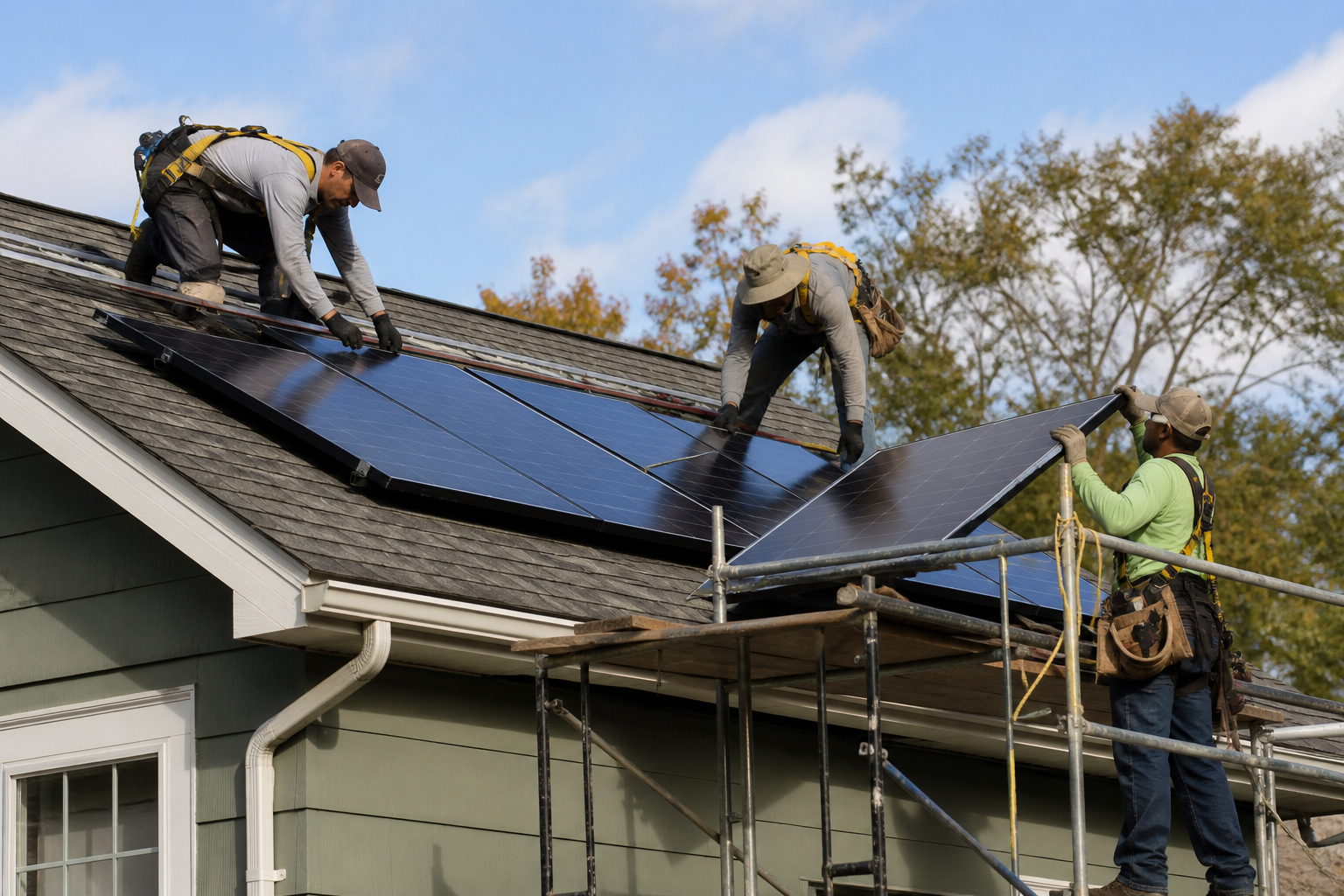
How an installer acquires you as a customer is one of the largest and least visible cost components. Door-to-door sales organizations typically spend $3,000 to $6,000 per closed deal on sales rep commissions, marketing materials, and management overhead. Call center and digital lead providers charge $500 to $2,000 per qualified appointment. Bidding platforms, including the one behind our quote request, tend to compress acquisition costs by delivering competitive, intent-driven leads rather than cold contacts.
These costs are embedded in your price per watt. If two installers use the same hardware and the same labor crew but one's price is $0.40/W higher, the difference is often sales channel overhead. This is not inherently dishonest, companies need customers, but it is something you should be aware of when evaluating why one bid costs more than another with identical equipment.
Comparing quotes
Normalize every proposal to price per watt using the DC system size. Calculate it yourself: total price divided by DC watts. Then check that system sizes are similar, a quote for 6 kW at $2.60/W and a quote for 8 kW at $2.50/W are not competing on equal terms if your usage justifies the larger system. Compare module brand, inverter type, warranty length, and included adders side by side. Create a simple table with these columns and the gap between bids will become obvious and explainable.
Sales tax and permit fees
Sales tax treatment of solar equipment varies by state and can swing total cost by 5 % to 8 %. Roughly 25 states exempt solar energy systems from state sales tax entirely. In states that do tax solar, the tax applies to the full contract price, equipment and labor, not just hardware. On a $20,000 system in a state with a 7 % sales tax and no exemption, that is $1,400 added to your cost. Some installers in non-exempt states structure contracts to separate taxable equipment from non-taxable services, but the legality of this approach varies. Ask your installer how sales tax is handled and verify with your state's department of revenue if the treatment seems aggressive.
Permit fees are another line item that varies dramatically by jurisdiction. Simple online permits cost $100 to $300. Complex plan-check jurisdictions with structural review requirements charge $500 to $1,200. Some counties assess permit fees as a percentage of project value, 1 % to 2 % of the contract price, which can push permit costs above $400 on a typical system. Re-submission fees add another $50 to $200 if the initial application is incomplete or rejected. Your installer should include the expected permit cost in their proposal rather than listing it as an excluded variable.
Financing cost impact
How you pay for solar affects the true cost more than most buyers realize. A cash purchase is the simplest: you pay the proposal price and your savings start immediately. A solar loan adds interest and, critically, dealer fees. Dealer fees are lump sums the installer pays to the lending partner upfront, which the lender then embeds in your loan principal. A $20,000 system with a 25 % dealer fee becomes a $25,000 loan balance from day one. Your nominal interest rate may read 1.99 % or 2.99 %, but the effective APR after accounting for the inflated principal is often 7 % to 12 %. Demand the effective APR, not the nominal rate, and compare it against a home equity line of credit at 7 % to 9 % with no dealer fee.
Lease and PPA cost structure
Third-party-owned leases and power purchase agreements spread cost into monthly payments with no upfront outlay. The monthly rate is lower than your current electricity cost, that is the pitch, but most contracts include an annual escalation clause of 1 % to 3 %. Over 20 to 25 years, that escalation can push your combined solar-plus-grid cost above what you would pay without solar. Read the escalation clause carefully and model total payments at year 10, 15, and 20. Prepaid leases, where you pay a lump sum upfront for a TPO structure, can offer competitive economics because the provider claims the commercial ITC and passes the benefit through, but you forgo ownership and the system sits on your roof under someone else's title, which complicates a home sale.
When to walk away
Walk away from pressure to sign the same day, no legitimate discount evaporates overnight. Walk away from refusal to itemize pricing. Walk away from warranties that are contingent on the installing company remaining in business, with no manufacturer backstop. Walk away from a price per watt that sits far above local comps without a clear, documented reason like a major electrical upgrade or premium equipment. Cross-check with 2026 costs and ROI analysis before committing.
If you can't explain every major dollar on the proposal to a skeptical spouse or friend, don't sign yet. A good installer will welcome the scrutiny. A predatory one will push urgency.
Common questions
Should price include roof work?+
Only if specifically scoped and documented. Otherwise get a separate roofing bid so solar pricing doesn't obscure the true cost of shingle replacement or repair. Bundling can work but only with transparent line items.
Is the lowest bid best?+
The lowest credible $/W with clear scope, local warranty support, and a documented track record. The lowest teaser price from a company you can't verify is a risk, not a deal.
What about 'free solar' offers?+
These are typically TPO leases or power purchase agreements. Read the annual escalation clause, the buyout terms at various years, and what happens to the agreement if you sell your home. 'Free' means no upfront cost, not zero cost over the contract term.
Become a subscriber
Free updates on costs, incentives and panel tech, written for homeowners, not sales teams.
Become a subscriber →